
Calmalo
A product made, mostly, of what I took out
No account, no streaks, no notifications. The hard part of Calmalo wasn't what it has, but everything I decided it wouldn't have.
It's 3:12 in the morning. Your heart is going faster than it should and your head faster still. You pick up your phone looking for something that helps, and what you find is a login screen. Then a catalogue of forty exercises. Then a notice that you lost your streak.
Calmalo was born from that scene. Not from a market or a trend. From the feeling that, right at the worst moment, everything in your pocket wants something from you.
What it's
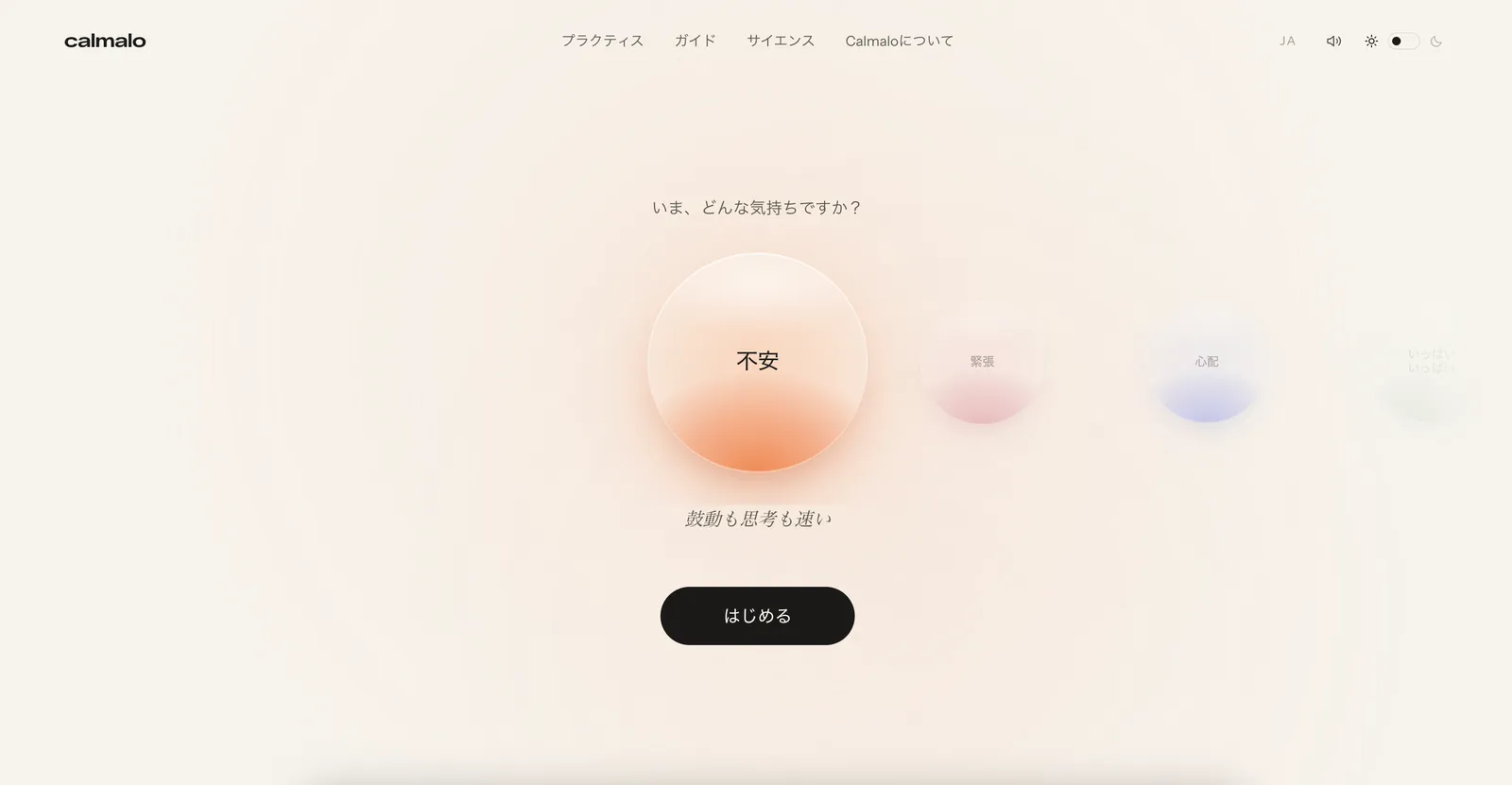
You open the site and it asks one thing: how you feel right now. Anxious, nervous, worried, overwhelmed, or "not sure". You choose, press start, and a sphere grows and softens in the middle of the screen. Breathe in as it grows, let go as it softens. About five minutes. At the end it says: "You're here. You can go on."
Behind it are four practices, one for each state. If you don't know what you feel, it takes you to the gentlest. It doesn't make you choose more than you have to.
The list of what it doesn't have
The part I'm proudest of can't be seen. It's written on the site almost as a statement: no account, no countdown, no streaks, scores or history, no notifications, no congratulations.
I had to decide to take out each of those, and some cost me. Everything you learn about product pushes you to measure, to retain, to bring people back. Here every one of those tools worked against what I wanted to make. A streak turns breathing into a chore. Congratulations at the end remind you there was something to complete, and there was nothing to complete. Only being there for a while.
Even the session progress is a hairline that slowly closes around the sphere, with no clock and no numbers.
The problem with measuring nothing
Here comes the uncomfortable part. If there's no account and no history, and the cookie notice literally says that what you feel is never measured, how do I know it works? I don't know whether anybody comes back. I don't know whether it helped anyone at three in the morning.
I designed, on purpose, a product that tells me nothing about itself. For someone who always says you should look at what people do and not what they say, that's a contradiction I haven't resolved. It has no business model either. Right now Calmalo is something I think should exist, not something I know how to sustain.
Six languages before launch
Something else I'll own: Calmalo is in six languages, Japanese included, with guides on what to do during a panic attack or how to stop going round in circles at night.
There's a logic to it. Anxiety doesn't care about languages, and at three in the morning nobody looks for help in a language that isn't theirs. But it's also true that I translated into six languages something almost nobody had used yet. It's exactly what I say you should avoid: making it bigger before you know the small version works. I did it anyway.
The responsibility
Making something for people who are having a hard time isn't like making a productivity tool, and I kept that in mind the whole way. That's why there's a page with the scientific references for each technique, and not just nice sentences. And that's why there's an urgent-help page with real phone numbers. Calmalo can help in a bad moment. It doesn't replace anyone, and I didn't want it to look as if it did.
What I'm taking from it, so far
- That taking things out is design too, and sometimes the hardest part. The list of what Calmalo doesn't have cost me more than any screen.
- That there are products where the usual metrics do harm, and that this doesn't excuse you from knowing whether they work.
- That words are product too. The error page says: "This page isn't here. You're, though." That line did more for the tone than any colour.
Screenshots
More work