
Welfitlab
The perfect plan lasts three weeks
An app that turns exercise into a habit: consistency first, then strength, then the rest. No watch, no streaks and no food logging.
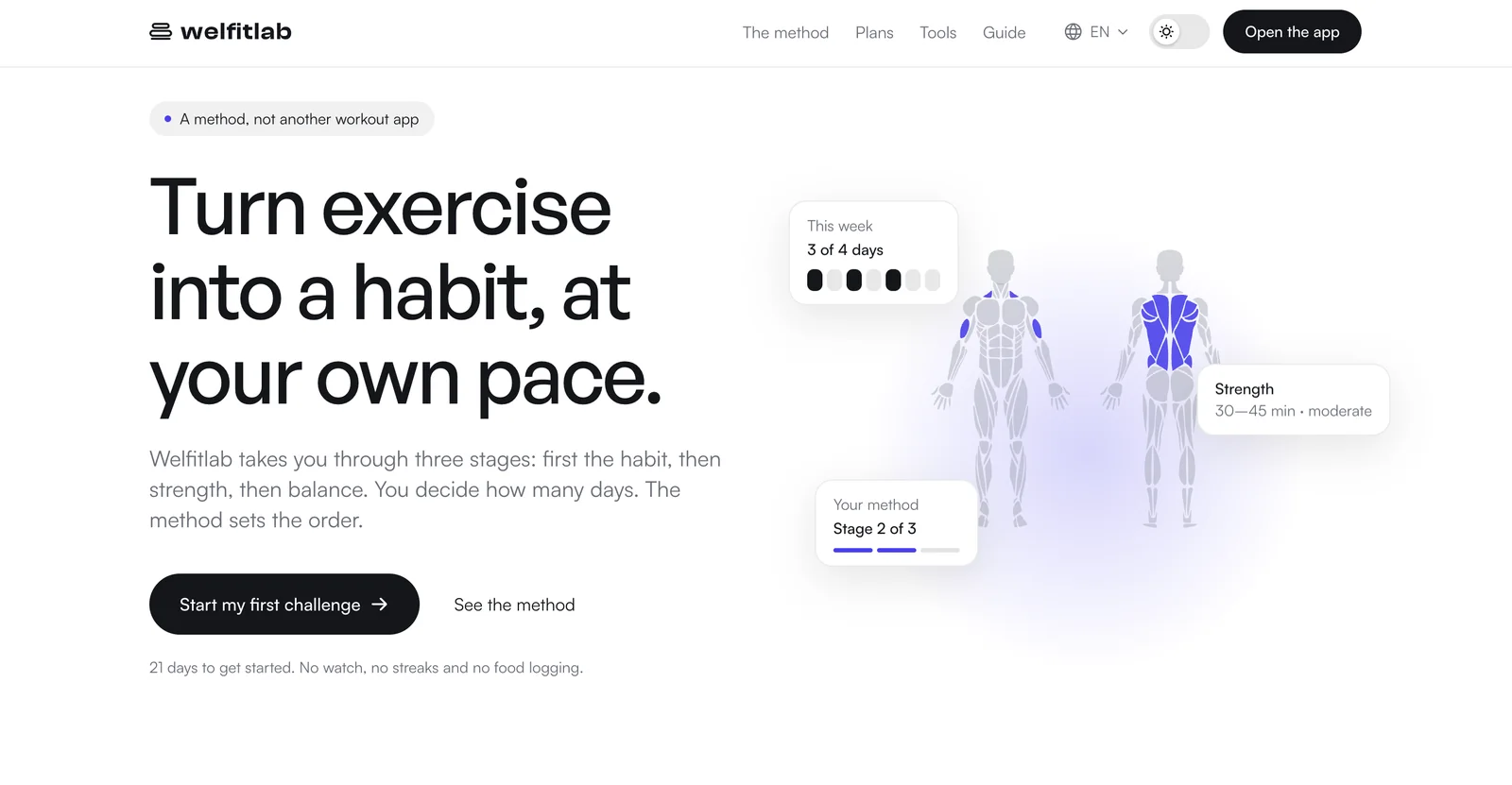
January. You join a gym, download an app and write yourself a five-day plan with its sets and its rest times. The first week you do all of it. The second, nearly. The third there is a trip, or a cold, or simply a bad Tuesday, and the streak breaks. And with the streak, everything else.
The plan did not fail. The plan was good. What failed is that it asked for too much, too soon, from someone who was not yet in the habit of moving. Welfitlab comes from there: from thinking that the order matters more than the plan.
The idea
Welfitlab is a method in three stages. First the habit: moving a few days a week, whatever you do, and you decide how many. Then strength, once or twice a week, once the habit is there. And finally the whole picture: how you sleep, how you eat and how you feel.
You move forward through 21-day challenges, and you pass a challenge by meeting your goal in two out of three weeks. That rule is probably the most important decision in the product. It says, in numbers, that a bad week is not a failure.
Weeks, not streaks
Daily streaks work very well until the day they break. That day you do not lose a day, you lose the reason to come back. So here the goal is weekly and you set it. If you get ill or go travelling, you mark a break and the week adjusts to the days you actually had.
It is the second time I have taken streaks out of a product. In Calmalo they had no place because they turned breathing into a task. Here they have no place because they punish exactly the people who find it hardest.
Ten seconds a day
Logging has to cost less than not logging. You tap what you did and the day is recorded. Any activity counts: walking, swimming, yoga, a match with friends. If you like, you add how long and how hard, always in approximate ranges.
The approximate part is on purpose. You do not need a watch or a band. You do not log what you eat either: the app guides you in portions measured with your hand, and each day you only answer how you ate and how you slept. I would rather have a vague figure someone writes down for a year than an exact one they stop writing down in March.
There is one screen I am fond of: a figure of the body where you mark the areas you worked and see at a glance which ones you have not touched in a while.
The awkward number
The challenges last 21 days, and the site itself says a habit is not built in 21 days. Studies point to about two months, with wide variation between people. It is not an oversight. Twenty-one days is a stretch you can see the end of; two months is not. That is why the challenges chain together: three make 63 days, roughly what the habit takes to settle.
It seemed more honest to use the number that encourages and put the true one right beside it.
The responsibility
Telling someone how much to move, how much strength work to do or how much to eat is not a game. I am not a doctor or a trainer, and the site says so plainly: the content has not been reviewed by a health professional and does not replace one. What it recommends comes from public guidelines and peer-reviewed studies, every article links its sources and, when a figure only shows association and not cause, it says so.
And the method adapts to whoever arrives. Starting at thirty is not the same as starting at sixty, or with a sore knee as without one.
What I threw away, and what I did not
The first version was something else: a complete coach that decided every session from your age and your goal. It was well thought out, and it was exactly what I have just criticised, the perfect plan. What I published starts with something much smaller: that you move a few days a week.
What I did not manage to make small is everything around it. Welfitlab launched in two languages, with plans by goal, calculators and a guide full of articles. Once again, the building before the neighbours.
What I am taking from it, so far
- That in a habit product the order is the product. The same things, asked for in a different order, get abandoned.
- That the "two out of three weeks" rule may do more for consistency than any reminder.
- That the less you ask people to measure, the longer they keep measuring. Or so I think. I still have to see it.
Welfitlab has been open for a very short time. The real question is not how many people start a challenge, which is the easy part. It is how many start the second one.
Screenshots
More work
 HivefoReservations openA shared map of hexagons for independent projects
 ObiblionWaitlistDigital parcels on eight planets, with your name
 RoomealoWaitlistFlatmates matched by how you live, not by price
 DiceandoLiveA few questions, and it picks where you travel
 CalmaloLiveFive minutes of guided breathing when anxiety arrives